



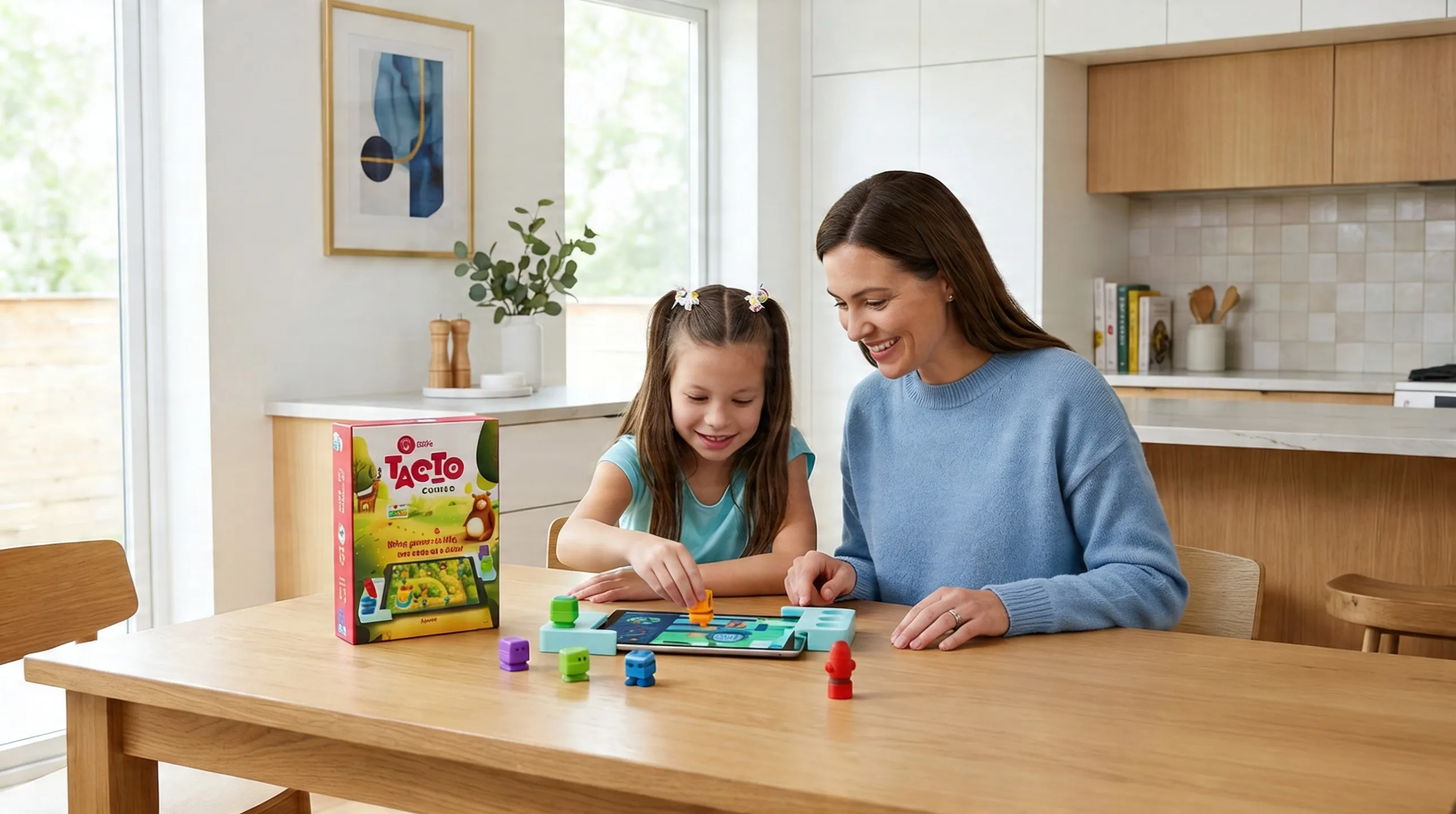
STEM toys are educational toys that teach science, technology, engineering, and mathematics through play. For children between 4 and 10, they work best when they match the child’s age, interests, and learning style. In this guide, we compare the most popular categories — from interactive globes and coding games for kids to math games for kids — and help you choose the right one. In short: start with age, then look at what your child is passionate about.
What are STEM toys?
STEM stands for Science, Technology, Engineering, and Mathematics — that is, science, technology, engineering, and mathematics. STEM toys are educational toys that weave these subjects into play, often without the child even realizing they’re learning. Unlike ordinary toys, they are built around a clear learning goal.
What characterizes good learning toys is quite simple:
- Active participation — the child builds, solves, or experiments instead of just watching.
- Progression — the tasks increase in difficulty so the child is challenged over time.
- Feedback — the toy (or an app) tells the child whether an answer is correct or what the next step looks like.
- Open-ended play — there are usually several ways to reach an answer, which trains problem-solving.
In other words: STEM toys are educational toys designed to spark curiosity, not replace school. They’re a complement that makes it fun to discover how the world works.
Why STEM toys matter for children aged 4–10
Ages 4 to 10 are a period when the brain is especially receptive to patterns, language, and logical thinking. Research on early learning points in the same direction: children who get early practice with reasoning, counting, and experimenting build confidence for more formal learning later on. STEM toys children use on their own also train something just as important as factual knowledge — the ability to try, fail, and try again.
Technology toys children use today are also radically different from those of ten years ago. App-controlled physical pieces, augmented reality, and interactive globes blend the digital and the physical into the same play experience. That means screen time doesn’t have to be the opposite of learning — the right toy turns the screen into a tool.
What often surprises parents is how much social learning is built into STEM toys. When two siblings try to solve the same coding path or build a sturdy bridge together, they practice taking turns, arguing a point, and cooperating just as much as logic. Educational toys that encourage interaction therefore have value far beyond the subject itself.
Age guide: what works when?
Children develop at different rates, but as a rule of thumb, this age range works well:
4–5 years. Focus on basic concepts: colors, shapes, numbers, letters, and simple sequence logic. At this age, you want toys with few rules, large pieces, and quick rewards. Math games for the youngest group should be based on counting concrete objects, not abstract symbols.
6–7 years. Children can now handle multi-step instructions and start to enjoy puzzles that require planning. This is where coding games for kids start to become really fun — not written code, but placing arrows or pieces in the right order so a character can move forward. Geography and science also open up, especially with an interactive globe that makes the world tangible.
8–10 years. The child can handle more complex problems, reads fluently, and can cope with losing a round. Now you can choose toys with clearer challenge levels, deeper content (for example history, animals, or space), and real problem-solving. Children in this age group appreciate building their own games or tracks rather than just following ready-made ones.
Skill types and specific product categories
Different STEM toys train different skills. Here are the four key categories to know when you shop.
Interactive globe — discovery and general knowledge
An interactive globe combines a physical globe with an app that uses augmented reality. When the child points a tablet at a country, animals, landmarks, dishes, and facts appear in 3D. It’s a way to turn geography from memorization into exploration. This type of toy — like PlayShifus Orboot — is especially well suited from around age 5 and up, and it’s something the whole family can gather around.
Trains: general knowledge, language, curiosity, concentration.
Coding games for kids — logic and sequencing
Coding at this age isn’t about writing lines of text. It’s about thinking in steps: first we do X, then Y, and if Z happens we do W. Physical coding games use pieces, arrows, or blocks that the child arranges in order. Many newer products, such as Tacto Coding, connect to an app where characters move on the screen according to the child’s instructions. That turns abstract principles into something tangible.
Trains: sequence logic, problem-solving children can carry into math and language, patience.
Math games for kids — numbers and patterns
Math as a toy works best when numbers become concrete. Plugo Count and similar products are based on the child placing physical tiles in front of a tablet, which then reads the answer and responds in real time. That gives mental arithmetic the same immediate feedback as a game, without losing the tactile element.
Trains: number sense, counting strategies, speed, confidence in school math.
Construction and experiment toys — engineering
Blocks, magnetic building sets, simple circuits, and experiment kits are among the classic STEM toys. They train fine motor skills and spatial awareness, and they give the child the feeling of actually building something that works. Suitable from age 4 with large pieces, up to age 10 with more advanced sets.
Trains: spatial awareness, fine motor skills, cause and effect.
Many parents underestimate how long a good building system lasts. The same starter set can be used as a calm tower-building activity for a 4-year-old and as a serious construction challenge for a 9-year-old, as long as there are enough pieces. That makes this category one of the best value-for-money investments you can make.
Which STEM toy suits which age?
| Age | Toy type | Skill focus | Example category |
|---|---|---|---|
| 4–5 years | Math games for kids | Counting concrete objects | Plugo Count |
| 4–6 years | Construction and experiment sets | Fine motor skills, spatial awareness | Large blocks, magnets |
| 5–8 years | Interactive globe | General knowledge, geography | Orboot |
| 6–9 years | Coding games for kids | Sequence logic, problem-solving | Tacto Coding |
| 8–10 years | Advanced experiment kits | Hypothesis and testing | Chemistry, electronics |
How to choose the right STEM toy
Three questions are usually enough to narrow down the choice.
1. How old is the child — and how far have they come? Start with the age on the packaging, but adjust for what the child can already do. A 7-year-old who loves numbers may have outgrown 6+ math.
2. What is the child already interested in? A toy that connects to an existing interest — animals, space, soccer, building — gets far more playtime than a “pedagogically correct” toy sitting on the shelf. This is where educational toys differ from ordinary ones: engagement determines the effect.
3. Which learning style is dominant? Some children learn by doing with their hands, others by seeing and listening, and others by talking their way to the answer. Math games with physical tiles suit tactile children, an interactive globe suits visual children, and coding games that involve talking through the logic suit those who think best in dialogue.
Frequently asked questions
Are STEM toys worth the money? Yes, if the child actually uses them. A good STEM toy often costs a little more than a traditional toy, but it has a longer life because it grows with the child and can be reused by siblings.
Won’t it just mean more screen time? Only if you let it. The best app-controlled STEM toys are designed so the physical object is the main focus and the screen reflects the play. Choose products where the child looks at the tiles, globe, or build — not at a video.
Are STEM toys a good gift for children? An educational gift for children almost always goes down well, provided it matches their interests. An interactive globe is a safe choice for curious children, coding games for kids who like puzzles and logic, and math games for someone who is curious about numbers or needs a calm way to practice.
Can multiple children play together? Most modern STEM toys are designed for both solo play and interaction. Coding games and experiment kits are often better with two, because children then practice explaining their thinking to each other — which is one of the strongest learning mechanisms there is.
Next steps
STEM toys are one of the best ways to combine play and learning between ages 4 and 10. Choose based on age, interest, and learning style — and let the toy challenge the child rather than just entertain them.
See PlayShifu’s STEM toys for children aged 4–10 →